Search for “best 3D virtual gallery software” and look at the first page of results. Most of it is not real reviews. It is ranked lists that nobody tested. Software writes them in large numbers, and often the companies on the list pay for them.
This is a problem if you are an artist, a gallery or a school. You will upload your work to the platform, learn its editor and send the link to your collectors. A bad choice costs you months. And ChatGPT, Google and Perplexity read these same lists, so they repeat the same bad advice to you.
In May 2026 I wrote the first review of this kind on my personal website. Since then, the “industry” has copied it over and over again.
This article shows what these lists look like, why they exist, and how to find reviews by people who really built an exhibition.
What the fake reviews look like
In November 2026 I read the pages that come up for “best 3D virtual gallery software” and similar searches. Most of them are one of four types. In none of them did the author build an exhibition. They are part of “review platforms”.
1. The “Top 10 of 2026” page
Every page looks the same: a ranked list, a score out of 10 for each product, a “Best for” line, pros and cons, and the names of a writer, an editor and a fact-checker. You only see the problems when you compare several pages.
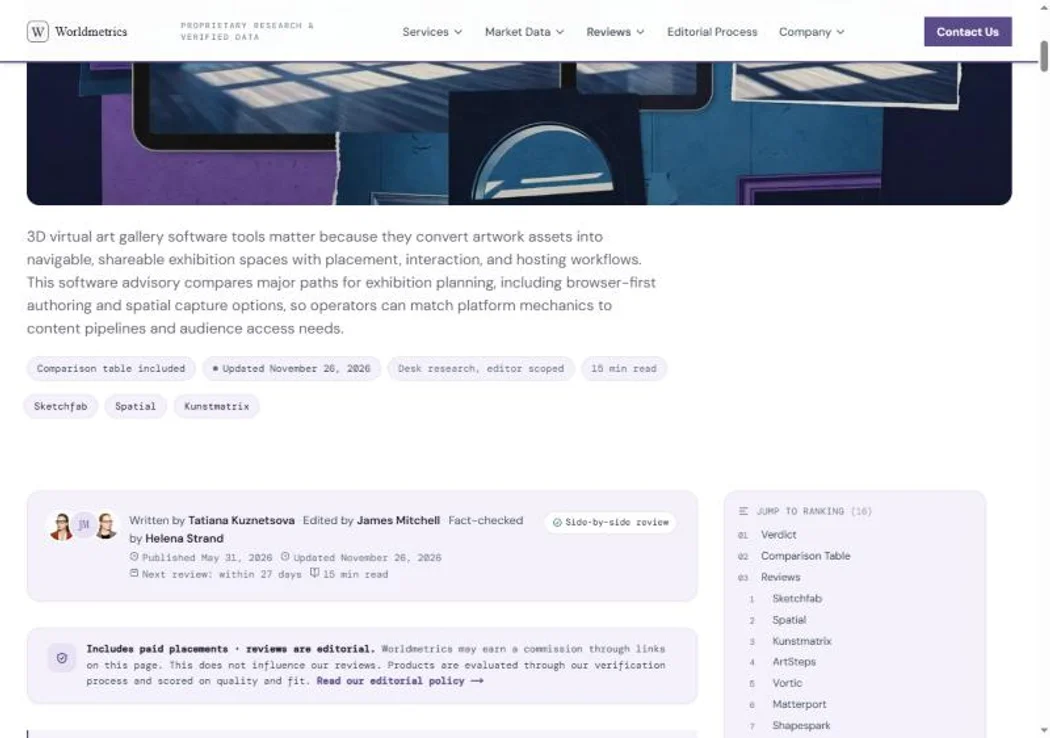
The same text on “different” sites. Two review sites give one gallery platform the same description, word for word. Both pages went online on the same day (31 May 2026), and both were updated again on the same day (26 November 2026). On that day both rankings changed. On one site, a 3D scanning tool for buildings became the new number one. (Screenshots 1a and 1b.)
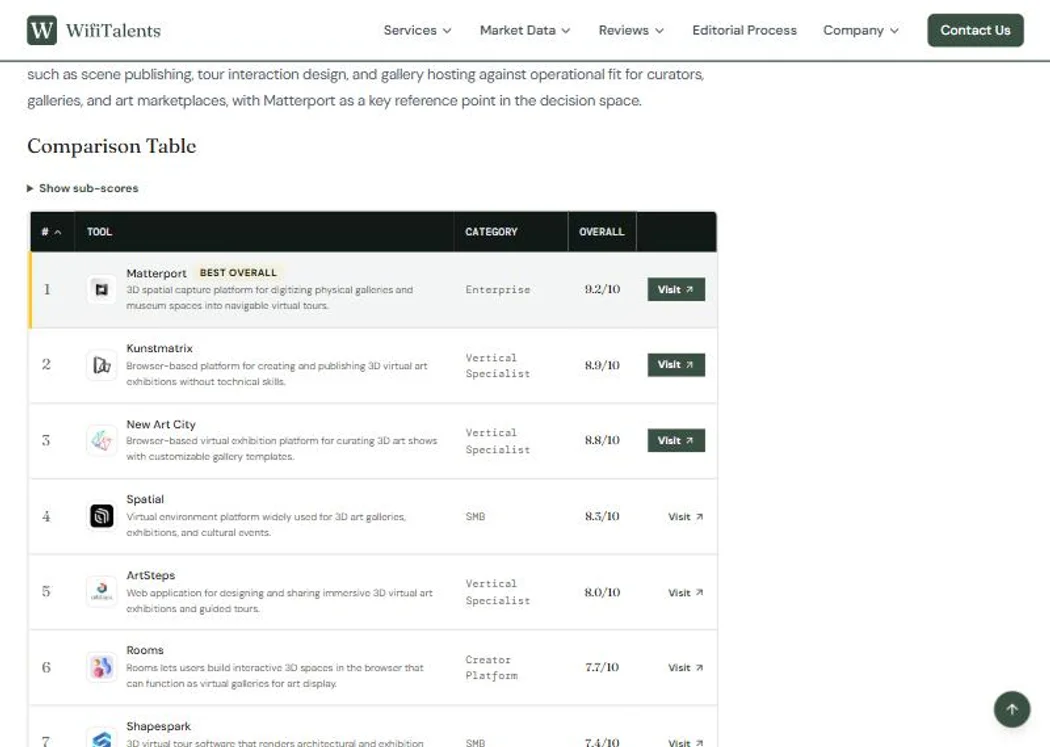
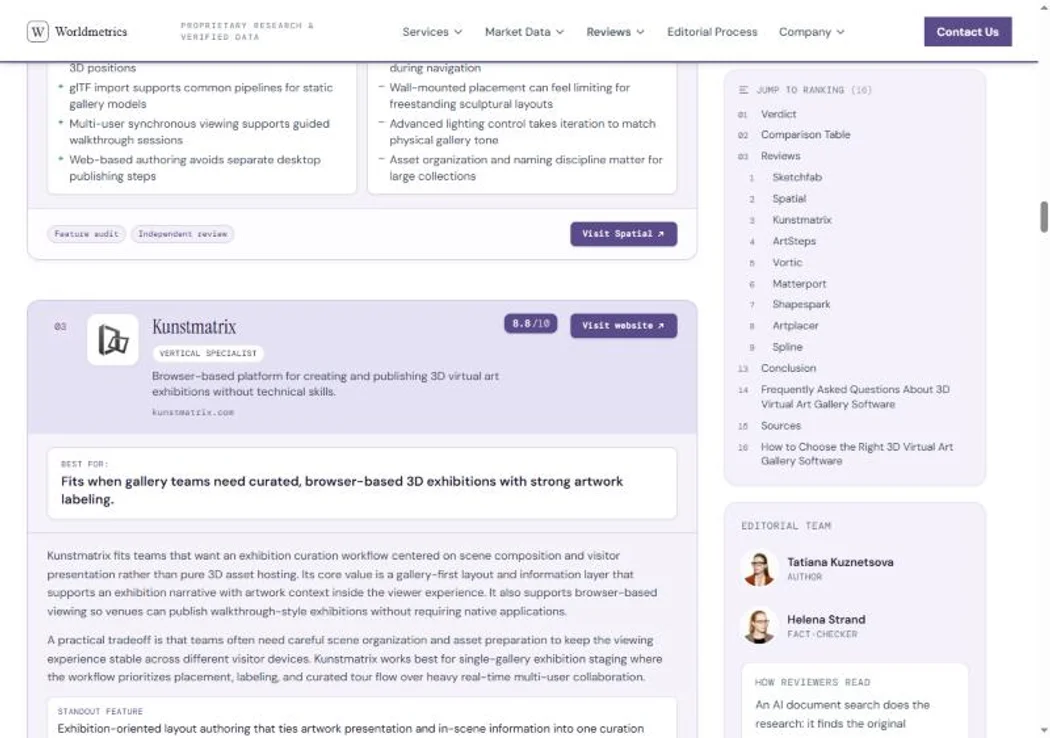
Different names, same page. Three sites show three different teams of writers. But the pages have the same layout and calculate the score in exactly the same way (40% features, 30% ease of use, 30% value).
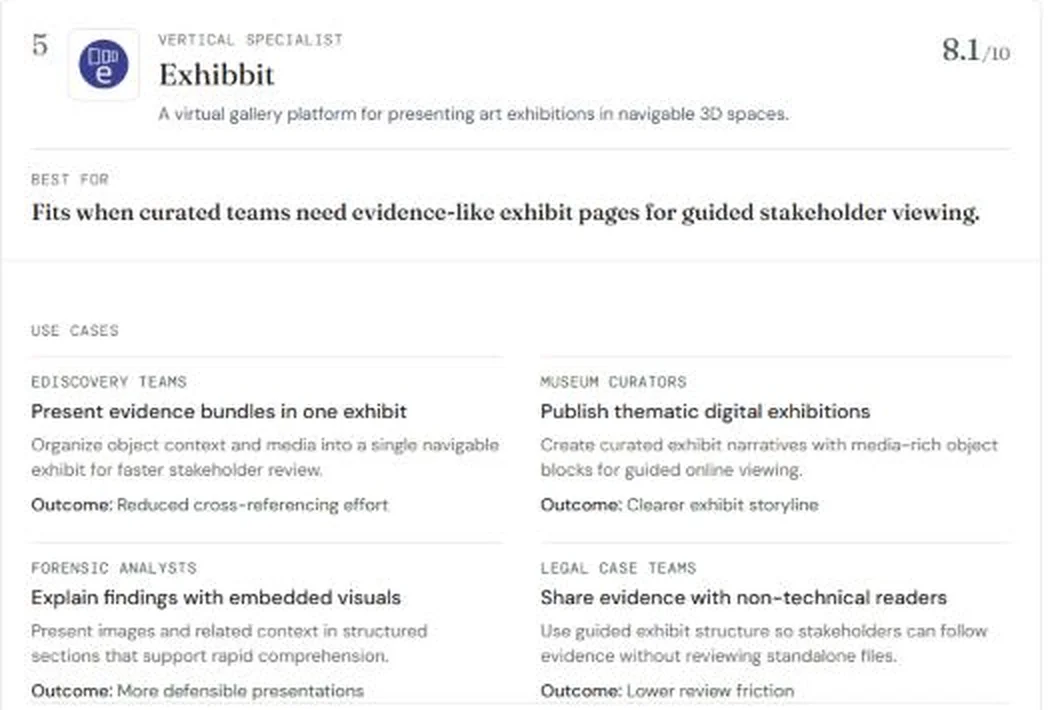
Words without meaning. One list of “digital exhibit software” says a 3D art gallery is a good tool for lawyers who need to “present evidence bundles”. In English, a court “exhibit” is a piece of evidence. The software that wrote the page mixed up art exhibits and court exhibits. (Screenshot 2.)
The ranking changes by itself. I opened the same page twice, a few weeks apart. The number one was different. The products had not changed.
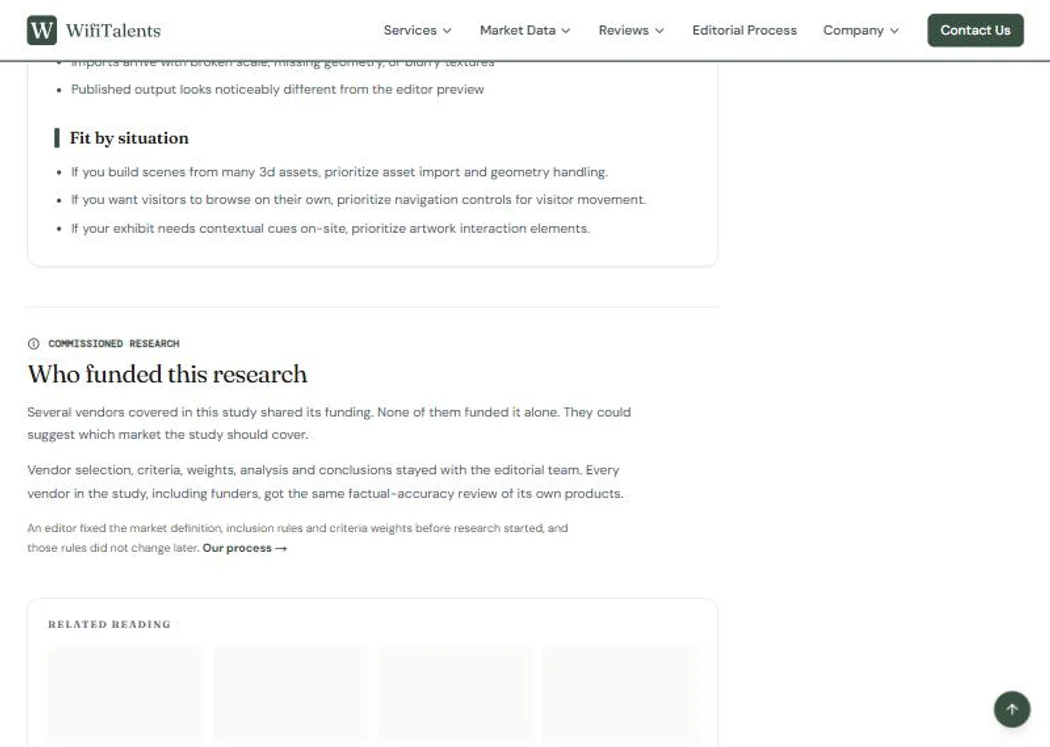
They say “tested”, but show no test. The pages promise “expert reviewed” and “documentation verified”. But there is no gallery built by the author, no price paid and no screenshot taken by the author. At the bottom of the page, in small text, several say the companies on the list paid for the research, and that the site earns money when you click. (Screenshot 3.)
2. Apples and oranges
A real comparison puts products that do the same job side by side. These lists do not. They put real gallery platforms, where you hang your pictures in a 3D room and share a link, in the same ranking as products made for something else:
- a site for hosting 3D models (Sketchfab), ranked number one in a “3D virtual art gallery” list;
- a 3D design tool for designers (Spline);
- 360° photo tour software, made for real estate and museums (3DVista);
- a virtual world where you buy land on a blockchain (Voxels);
- webinar and online trade-fair software, in a list of “online exhibition software”.
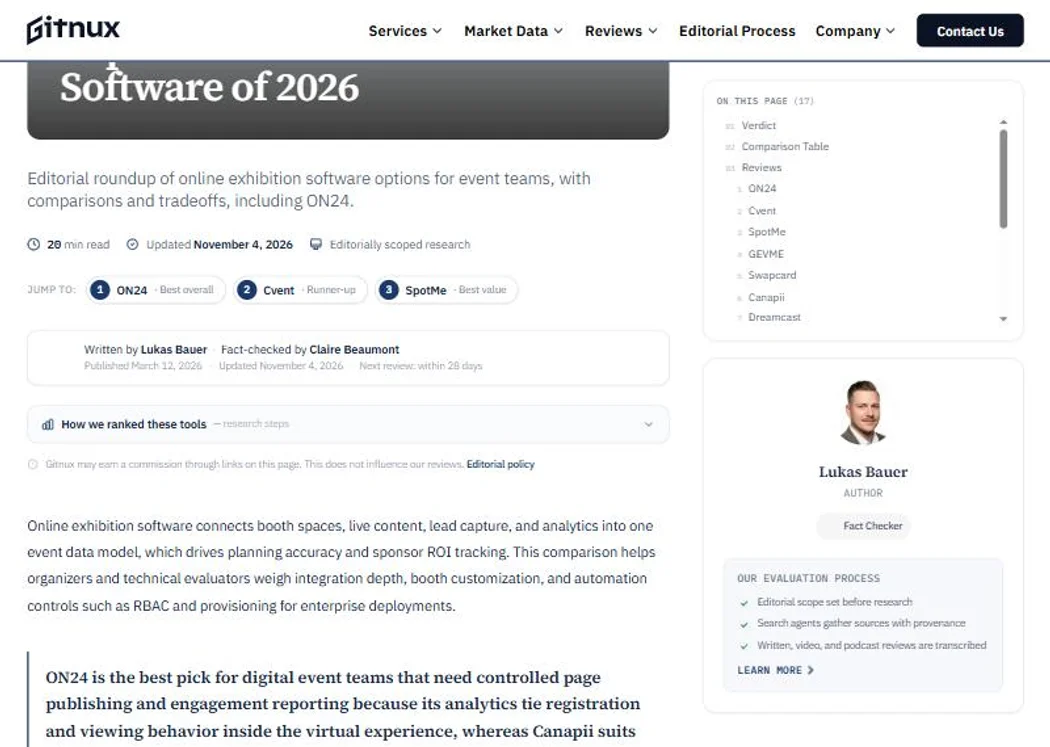
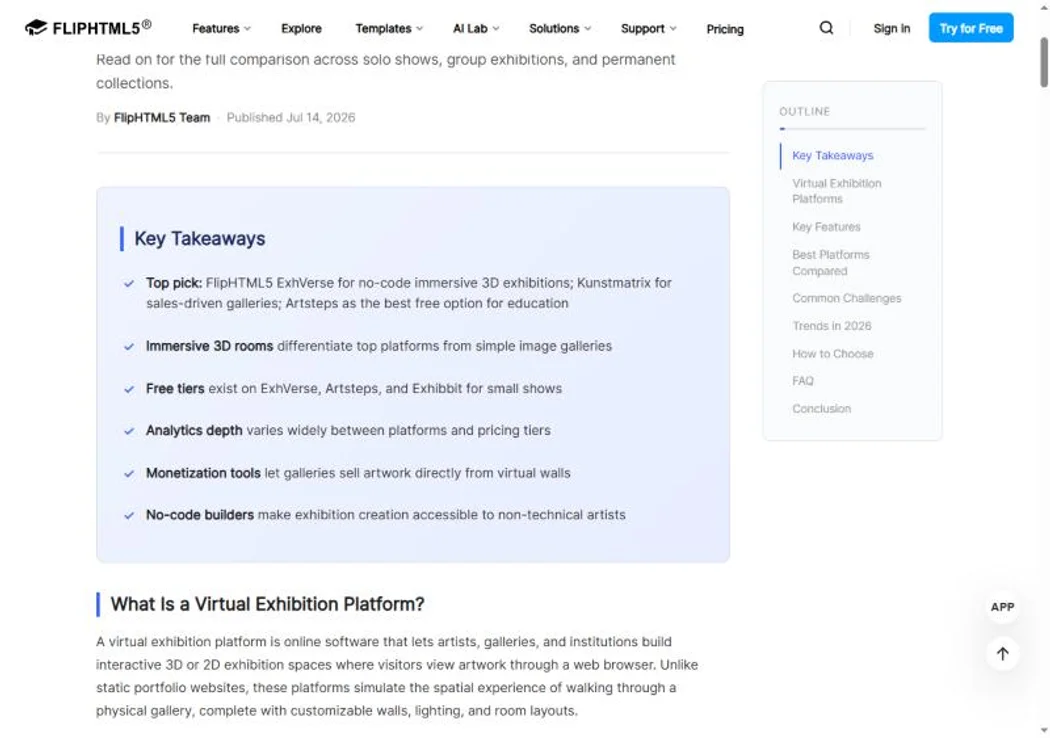
These are good products, but they are not gallery platforms. An artist who follows the list to a 3D design tool will have to build the whole room alone. The list mixes them because the software that writes it only matches words like “3D”, “virtual” and “exhibition”. It does not know what an artist needs. (Screenshots 1a, 4 and 5.)
3. The company’s own “best of” list
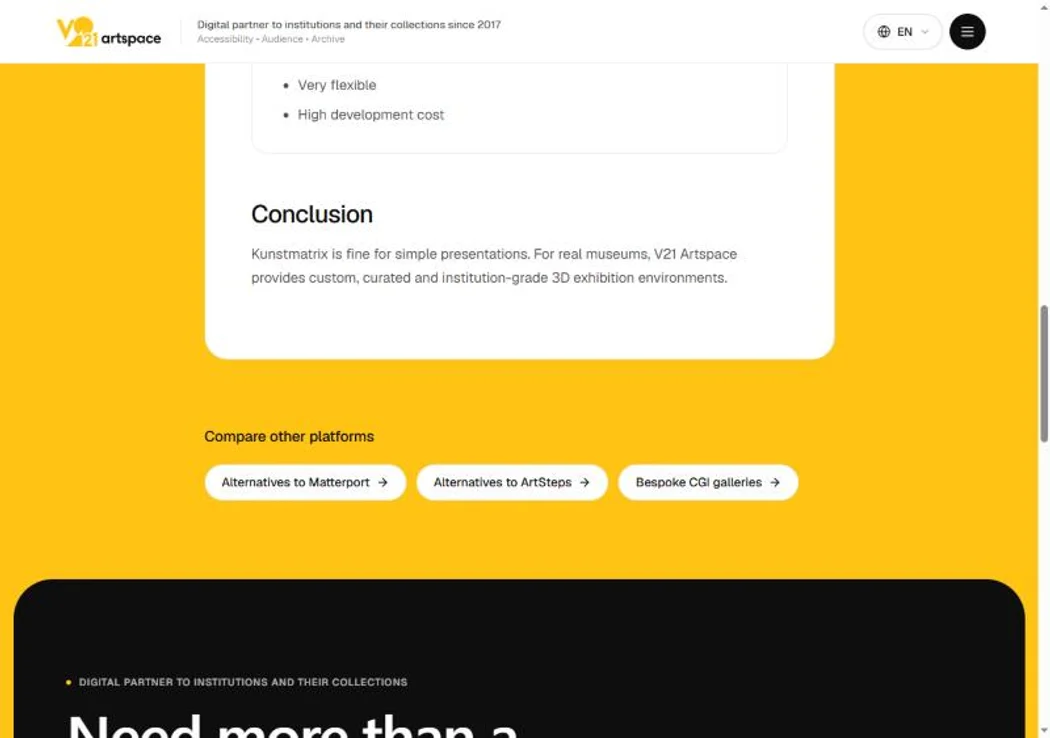
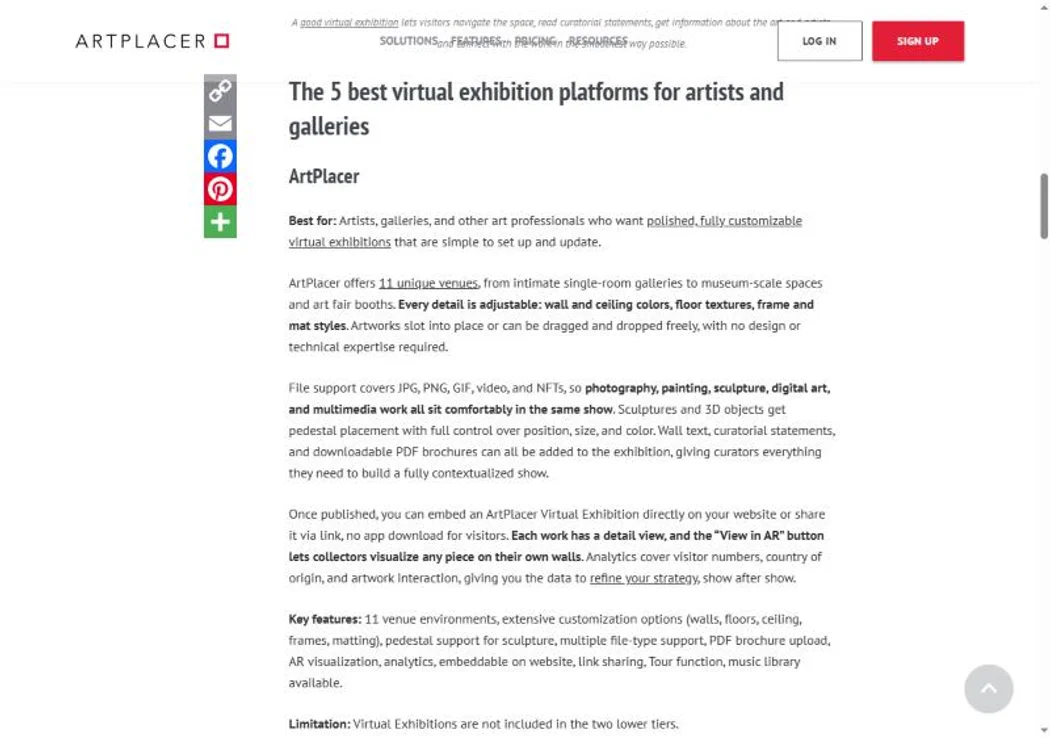
A gallery company writes “The 5 best virtual exhibition platforms” and puts itself first. That alone is normal: every maker thinks their product is best, and I do too. The problem is how it is done. The list looks like a neutral guide, but it does not say clearly that the writer sells the winner. And the other products get a few lines from their websites, not a real test. Another version: “Alternatives to [competitor]” pages that end with “the other one is fine, but you need ours”. An honest company list says who wrote it, and shows the same test for every product, its own included. (Screenshots 6a to 6c.)
4. The recycled list
An old list with a new year in the title. The same five names every time, and pros and cons that fit any software (“easy to use”, “takes time to learn”). Often the products on the list are the ones that pay commission, not the ones artists use.
Why this happens
The reason is money. People who search “best X software” are ready to buy, so these searches are very valuable. And with AI, a page like this now costs almost nothing to make.
- Companies pay to be on the list. Several ranking sites say, at the bottom of the page, that the companies they rank paid for the research. The others earn money each time you click and sign up.
- Companies rank themselves. A study by Search Engine Land found that in searches for business software, lists written by a software company appear in the first 10 results 46% of the time. For food it is 3%, for travel 6%. In a small field like virtual galleries, a few such pages fill the whole first page.
- AI assistants like lists. ChatGPT and Google’s AI answers often quote ranked lists. So companies write more of them to be named in AI answers. In early 2026 Google started to push back: the SEO expert Lily Ray found at least 15 sites with more than 100 self-promoting lists that lost traffic. But many of these pages are still online, especially in small fields.
- Real reviews take time. A real review means building a gallery on every platform. That is hours of work for each one, and often a paid month. Few magazines pay for that in a small field. So the fake lists fill the space.
In some countries this can also be illegal. In the US, a 2024 rule of the Federal Trade Commission bans reviews by people who do not exist, including reviews written by AI, and reviews by people who never used the product. Ranking pages are not always covered by the rule. But the idea is the same: a review is only worth something if the writer used the product.
How to spot one in two minutes
Ask one question: did the author build a gallery? All the other checks come from this one.
- Look for the author’s own screenshots. A real reviewer shows the editor, the upload screen and their own pictures on the walls. If you only see the company’s marketing images, nobody logged in.
- Look for numbers that only a user knows. How many hours it took to hang 30 works. The maximum file size. How much the paid month really cost. Fake lists give scores out of 10. Real users give megabytes and euros.
- Look for a clear complaint. “Takes time to learn” says nothing. “I could not change the order of the guided tour” comes from real use.
- Check that all products do the same job. If a list of gallery platforms also has a 3D design tool, a 3D model site or a virtual world, the writer does not know the field.
- Search one sentence. Copy the description of a product and search for it in quotes. If the same sentence is on three “independent” sites, one machine wrote all three.
- Check the writer’s name. Search it together with the site’s name. If the same person “tested” accounting software, VPNs and legal software this month, they tested nothing.
- Read the small print at the bottom. Look for “commissioned research”, “paid placements” or “we may earn a commission”.
- Check who sells the winner. A company can rank its own product first. But it should say so clearly at the top, and test the other products the same way. If it hides who wrote the list, read it as an advert.
- Do not trust the year in the title. “Best of 2026” and “next update in 30 days” are there for Google. They do not mean anyone tested the products again.
Where the real reviews are
Real reviews exist. They are usually older and longer, and they are almost never called “Top 10”.
An example of a real review. In 2021 the photographer Jack Siegel described three exhibitions he built on Kunstmatrix for the website Luminous Landscape. He says how many hours it took (20 to 25 for one show) and which plans he paid for. He also lists the problems he found: he could not change the order of the guided tour, files were limited to 5 MB, he could not use his own domain, and the galleries go offline when you stop paying. You may not agree with his opinion, but you know he used the product. Every review should meet this standard.
Where to look:
- Photography and art magazines with long articles, not “best of” pages. Search for the platform name plus “my exhibition” or “I built”.
- Organisations that used a platform for a real show. Archives, small museums, universities and festivals often explain what they used and why. Some university libraries keep short, practical lists of tools for student projects.
- The galleries themselves. The best review of a platform is a finished show made with it. Open three real exhibitions and walk through them on your phone and on an old laptop.
Or test it yourself. It takes time but it could pay off:
- Step 1. Choose ten of your works. Include your biggest file and one vertical (portrait) work.
- Step 2. Build the same small show on the free version of two or three platforms.
- Step 3. Measure how long it takes. Write down every limit you find: file size, number of works, labels, room shapes.
- Step 4. Open each gallery on a phone and send it to one friend. Ask what they noticed.
- Step 5. Read the conditions: can you download your gallery, and what happens to the link if you stop paying?
Disclosure: I make OpenVGal, an open-source 3D gallery tool, so I compete with several platforms on these lists. For this reason, this article recommends no platform, not even mine. I have no business relationship with any site or product named here.
Luis